Kathairos has emerged as the leading North American solution for methane elimination from pneumatics, with more than 2,400 systems in operation across North America and over 70 major oil and gas producer partners.
In this post
New Mexico’s ozone precursor regulations—effective since August 2022—require zero-emission pneumatic controllers and pumps at new oil and gas facilities, with a phased schedule to convert the majority of natural gas-driven pneumatics by 2030. These rules represent one of the most aggressive state-level pneumatic conversion timelines in the country.
The Regulation: NMAC Title 20, Chapter 2, Part 50
New Mexico’s methane regulations are codified under the New Mexico Administrative Code (NMAC), Title 20, Chapter 2, Part 50: “Oil and Gas Sector – Ozone Precursor Pollutants.” Effective August 5, 2022, these rules target methane and VOC emissions from upstream and midstream oil and gas operations across the state, with pneumatic controller and pump provisions particularly relevant for operators running gas-driven devices.
What the Rules Require: Controllers
New installations: All pneumatic controllers installed after the effective date must have an emission rate of zero.
Existing installations: Owners and operators of existing controllers must meet escalating non-emitting percentages based on their historic percentage of non-emitting controllers, measured against a 2023 baseline. The schedule differs based on facility type.
Table 1: Well Sites, Standalone Tank Batteries, Gathering and Boosting Stations

Table 2: Transmission Compressor Stations and Gas Processing Plants
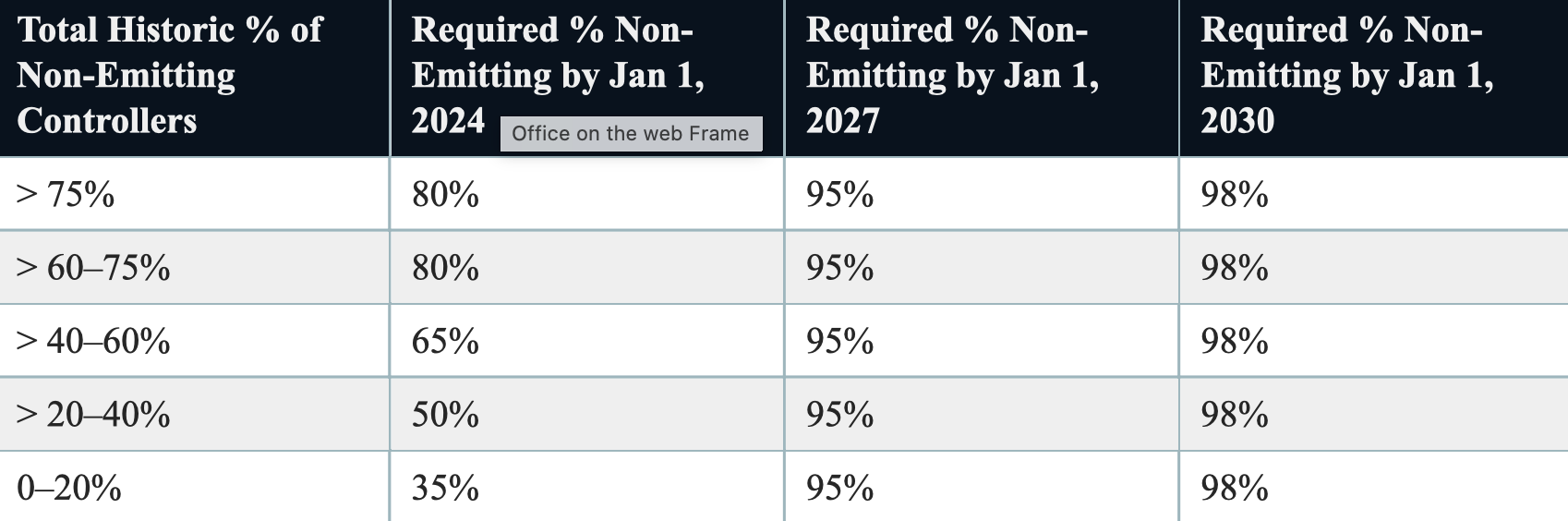
The structure is intuitive: operators who have already converted a greater percentage of their fleet have a head start and face somewhat lower incremental requirements. By 2030, every category of operator must have 80-90% of well site controllers and 98% of compressor station and processing plant controllers operating at zero emissions.
What the Rules Require: Pumps
The pump provisions follow a similar zero-emission mandate but with a key distinction based on power access:
- New pumps: Must have an emission rate of zero, regardless of installation date or power availability.
- Existing pumps with access to commercial line electric power: Must achieve zero emissions.
- Existing pumps without access to commercial power: Must route emissions to a control device achieving at least 95% emission reductions.
These requirements are effective as of 2024. For remote locations where grid power isn’t available, the 95% control device requirement still demands a real operational solution—not a workaround.
How New Mexico Compares to Federal Requirements
New Mexico’s regulations were finalized before the publication of US EPA’s Methane Rule (OOOOb/c), making the state ahead of the curve in many respects. However, the federal Emissions Guidelines under OOOOc require allpneumatic controllers and pumps to be non-emitting by 2030, while New Mexico’s phased schedule tops out at 80–90% for well site controllers and 98% for compressor stations and processing plants. The state’s regulations will likely needto be amended to fully align with EG OOOOc.
New Mexico’s methane regulations will ensure the industry is well positioned vis-à-vis other jurisdictions to achieve the full 100% conversion required under EG OOOOc. The staggered compliance requirements in New Mexico allow producers the opportunity to trial different solutions, secure supply chains, and deploy well-planned campaigns over multiple years, avoiding a rushed execution.
Why This Matters for New Mexico Operators
New Mexico is the second-largest oil-producing state in the country, and thousands of well sites, gathering stations, and compressor facilities across the state are subject to these requirements. The 2024 milestones have passed and someoperators may be struggling to meet the upcoming 2027 requirements. Many New Mexico sites are remote, off-grid, and widely dispersed—exactly the conditions where electrification and instrument air face logistical and economic challenges.
The Takeaway
New Mexico’s regulations demonstrate how states are driving pneumatic conversions in advance of federal timelines. The compliance clock is already running, and operators are in the process of planning their conversion campaigns to meet state (and impending federal) requirements for non-emitting pneumatics.
Nitrogen systems are especially well-suited to address any sites that still need to be converted – even remote facilities with lacking or unreliable power, Kathairos has deployed 3,000+ nitrogen systems across North America, including large-scale campaigns addressing thousands of pneumatic devices in a matter of weeks—with no external power, no moving parts, and no capital outlay.
If you’re operating in New Mexico and need to build a conversion plan that meets both state and federal requirements, we can help. Reach out at hello@kathairos.com to start the conversation.
This blog post is for informational purposes only and does not constitute legal or regulatory advice. Regulatory citations are drawn from the New Mexico Administrative Code, Title 20, Chapter 2, Part 50 ("Oil and Gas Sector – Ozone Precursor Pollutants"), effective August 5, 2022, and current as of May 2026. Operators should consult the full text of NMAC 20.2.50, any applicable amendments, and seek qualified legal or environmental counsel before making compliance determinations.
Explore more posts from Kathairos
Electrification? I Barely Knew Her: Why power access isn’t needed to eliminate methane emissions at remote well sites