Kathairos has emerged as the leading North American solution for methane elimination from pneumatics, with more than 2,400 systems in operation across North America and over 70 major oil and gas producer partners.
In this post
Colorado has been ahead of the curve on methane for over a decade. In 2014, it became the first U.S. state to directly regulate methane emissions from oil and gas. Since then, Regulation Number 7 (“Reg 7”) requirements have only tightened. The latest Reg 7 updates mean the phase-out of natural gas-driven pneumatics is no longer a distant concern, but a process already underway.
How We Got Here
The progression has been steady. In 2014, Colorado required non-emitting controllers at any site with grid power and mandated low-bleed conversions statewide. By 2021, all new or expanded well production facilities had to be entirely non-emitting, and companies were required to implement company-wide pneumatic reduction programs at existing facilities (with 2022 and 2023 milestones based on production-weighted calculations for wells and controller counts for compressor stations).
Starting in 2025, a greenhouse gas intensity verification in Colorado rule requires operators to demonstrate progressively lower carbon intensities through direct measurement and third-party verification, with thresholds tightening annually through 2030.
At a Glance
What is Colorado Reg 7's pneumatic phase-out deadline?
Colorado's Air Quality Control Commission set March 1, 2029 as the deadline to eliminate all remaining natural gas-driven pneumatic controllers statewide. Interim deadlines apply sooner: operators in the ozone control area need 50% of facilities non-emitting by May 2026, and operators outside it need 25% converted by the same date.
How can operators comply with Reg 7 without replacing existing controllers?
Operators can swap the supply gas rather than the device. Liquid nitrogen ties into existing pneumatic lines in about two hours and keeps every controller, pump, and regulator in service — no equipment retrofit required.
Which facilities have to comply first under Reg 7?
Compliance is based on each operator's total facility count as of May 1, 2023. Outside the ozone control area, operators must rank facilities by 2023 production and convert their highest-producing half first, by May 1, 2027.
February 2025 Reg 7 Changes: Full Pneumatic Phase-Out
On February 21, 2025, the Air Quality Control Commission adopted a new rule as part of Colorado’s 111(d) Plan. The updated requirements phase out all remaining natural gas-driven pneumatic controllers at well production facilities, compressor stations, and processing plants statewide by March 1, 2029.
The standard is zero emissions from natural gas-driven pneumatic controllers. Operators can comply by replacing controllers with non-natural gas-driven alternatives (such as nitrogen-powered pneumatics), routing emissions to a closed vent system, using self-contained controllers, or shutting down facilities. (Emergency shutdown devices are exempt from the phase-out).
Compliance is determined by the operator’s total facility count—defined as every facility that had natural gas-driven pneumatic controllers as of May 1, 2023. Compliance deadlines differ depending on the location of the facility, with different requirements for facilities located within the ozone control area and northern Weld County (see tables below).
Inside the 8-Hour Ozone Control Area / Northern Weld County

Outside the 8-Hour Ozone Control Area / Northern Weld County
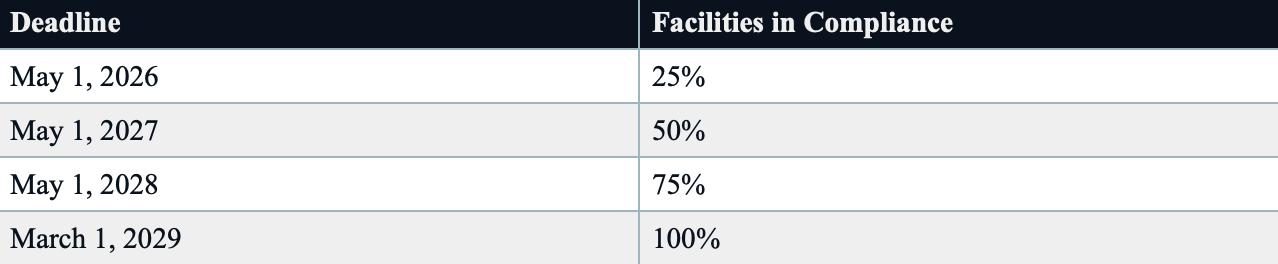
Operators outside the ozone area must determine which facilities to convert first by considering production volumes. Operators must rank facilities by 2023 production in descending order and must have addressed the top half of that list by May 1, 2027. Effectively, the highest-producing sites must be non-emitting first.
Reporting: Know What’s Coming
By December 1, 2025, operators had to submit an initial report listing every facility that had natural gas-driven pneumatics as of May 1, 2023, broken out by geographic zone. Starting June 30, 2026, annual compliance reports must demonstrate progress against the schedules above—facility by facility, with the compliance method documented for each. Asset transfers must be tracked, and facility counts revised accordingly. The data must be auditable and available at the facility level.
Federal Context
Reg 7 aligns with the US EPA’s requirements for non-emitting process controllers and pneumatic pumps by 2030 (as outlined in EG OOOOc). NSPS OOOOb requires zero-emission pneumatics at all new or modified facilities nationwide, and OOOOc mandates a full phase-out at existing sources by 2030. As a result, Colorado will likely not be required to make further substantive changes to its methane regulations as a result of the OOOOc State Implementation Plan process.
What This Means for Your Operations
The regulatory picture is unambiguous: natural gas-driven pneumatic controllers are being eliminated in Colorado. These staggered compliance requirements are large but achievable; they don’t need to be daunting but do require planning.
The first deadlines are here: Operators in the ozone area need 50% of facilities to be non-emitting by May 2026. Outside the ozone area, 25% of facilities must be non-emitting (starting with companies’ highest-production sites).
Reporting demands data: Every facility needs defensible records. Kathairos’ Atlas platform delivers real-time nitrogen consumption and methane displacement data from every deployed system.
Simplicity enables scale: Liquid nitrogen requires no external power, no moving parts, and no infrastructure build-out. A single cryogenic tank ties into existing pneumatic lines in a two-hour installation. Hundreds of tanks can be shipped a month; deploying the first tank is as easy as the thousandth.
Colorado operators have navigated over a decade of tightening pneumatic regulations and have demonstrated true global leadership in reducing methane emissions. Reg 7 requirements are rigorous but achievable with simple, scalable solutions. If you’re planning a conversion program, talk to Kathairos. We’ve already done it, reach out to us here.
.png)