Kathairos has emerged as the leading North American solution for methane elimination from pneumatics, with more than 2,400 systems in operation across North America and over 70 major oil and gas producer partners.
In this post
Instrument air (IA) failures are a routine operating reality. A compressor trips, a dryer fouls, a line freezes, header pressure falls, valves go to fail-safe and the site shuts in. The technicians who maintain IA own the recovery and answer for the downtime impact. Kathairos exists to give them time.
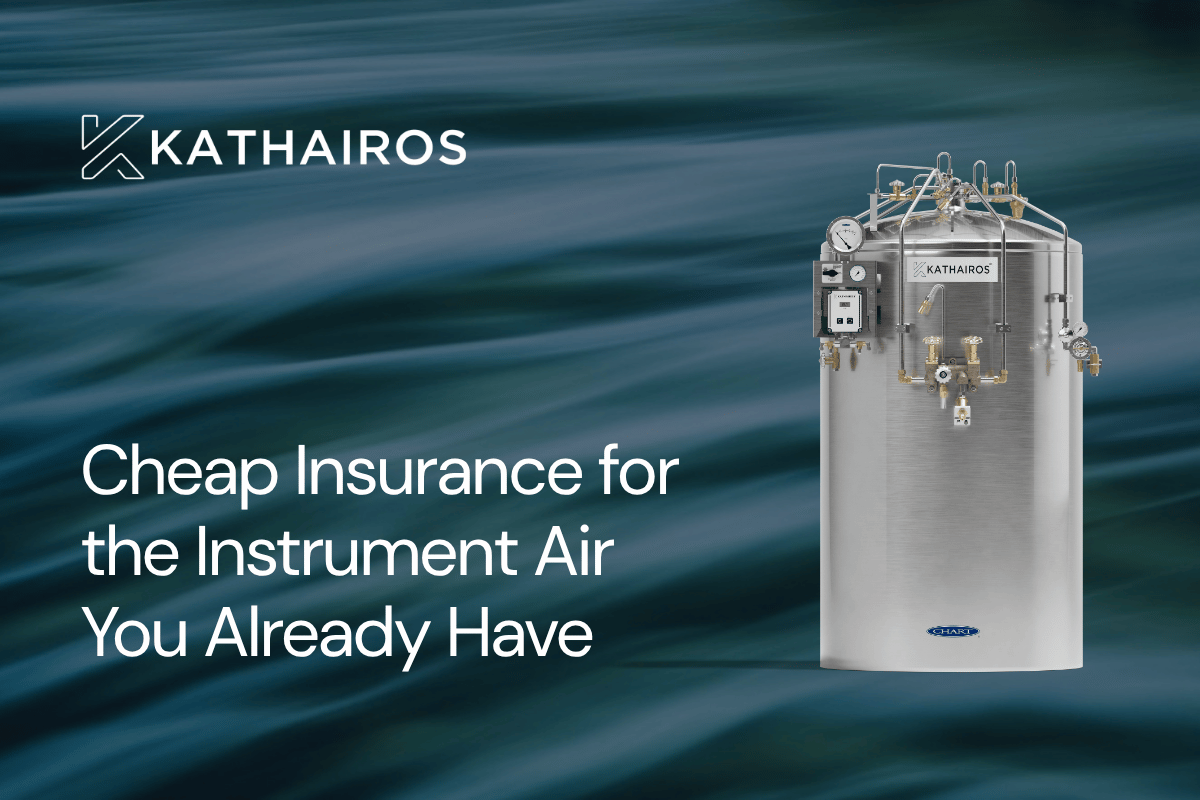
Kathairos fully replaces instrument air as prime pneumatic supply at sites that choose it. It also backs up the IA already installed. That is the application here: cheap insurance for the day IA goes down.
How the Backup Works
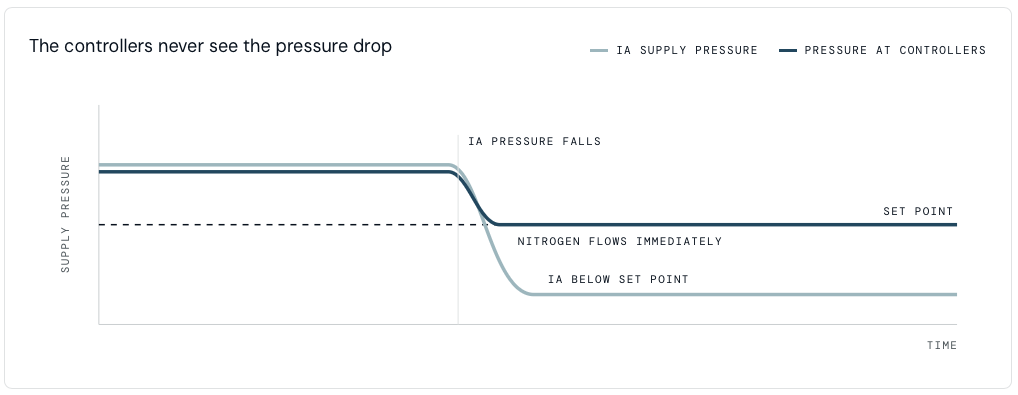
A Kathairos liquid nitrogen tank ties directly into the existing pneumatic supply lines. When IA pressure falls below an established set point, nitrogen flows immediately. Pneumatic controllers keep seeing supply pressure, so the site does not trip or shut in. The system requires no external power, has no moving parts and needs no operator action. Kathairos systems have logged more than 46 million operating hours at 99.99%+ uptime across 3,000+ deployments.
Sizing starts with the operator’s backup requirement: the days of operation the site must sustain if IA is lost, typically one to five. Kathairos combines that requirement with the site’s expected daily and hourly pneumatic demand and sizes the tank to fit. Because the tank backs up IA instead of serving as prime pneumatic supply, it is smaller than the Kathairos nitrogen systems deployed in that primary role.
What the Field Data Shows
From January through August 2026, Kathairos recorded backup activity across 48 sites, nine operators and seven basins:
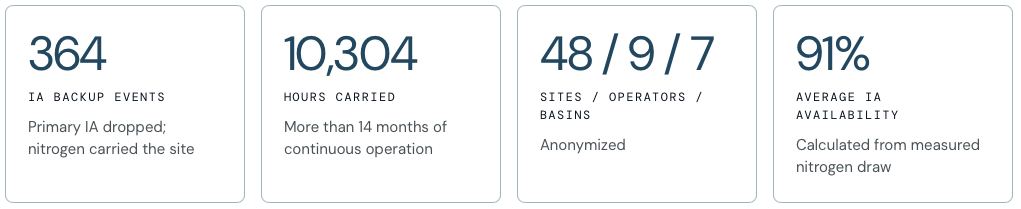
- 364 IA backup events, each a period when primary IA dropped and nitrogen carried the site
- 10,304 hours of continuous pneumatic service, more than 14 months of uninterrupted operation
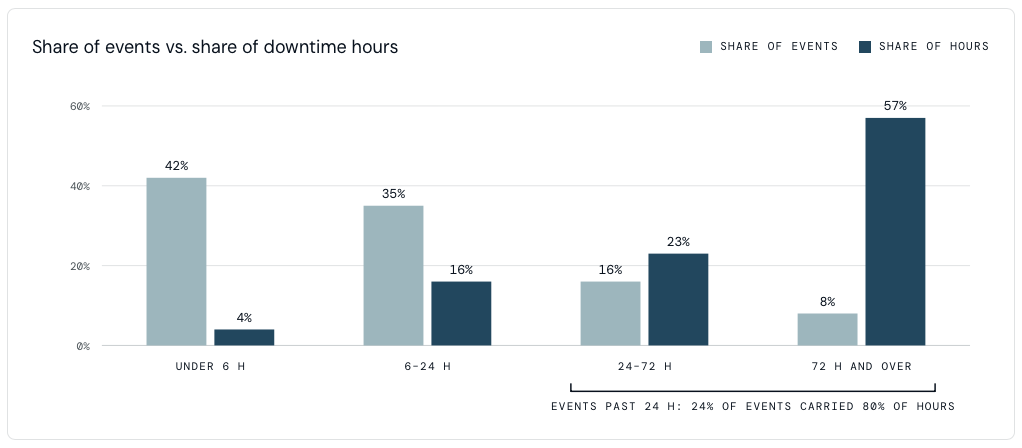
- 28-hour average event: 42% ran under six hours, 24% ran past 24 hours and the longest ran 740 hours
- 91% average IA availability, calculated from measured nitrogen draw
Nitrogen backup responded to every logged gap. Short events are the 2 a.m. trips. Long events test the sizing, which is why the operator’s backup requirement sets the tank. The trend sharpens the point: August averaged 46 hours per event against a six-month average of 31 hours. Duration, not frequency, drives exposure.
What 91% Availability Costs
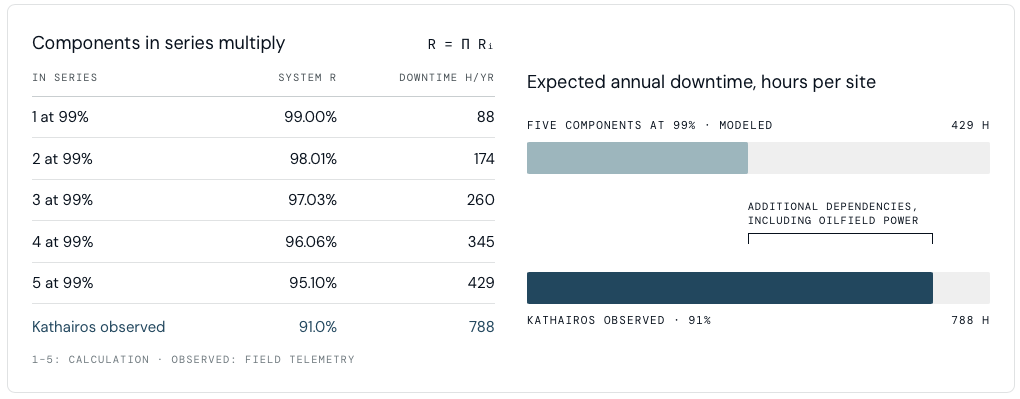
At 91% availability, IA is unavailable 9% of the time. That is 788 hours per site per year, roughly 33 days.
Reliability engineering explains why. Five individual IA system components, each 99% reliable, result in 95.1% system reliability, or 429 hours of expected downtime per year. Add oilfield power to that equation, a dependency remote sites do not always deliver, and the 91% Kathairos observes in the field is easy to understand. Compressors, dryers and filters are mechanical, and every component and dependency adds another term to the product. The exposure comes from architecture, not craftsmanship: one air supply with no second source. A skilled technician restores IA quickly and still loses the hours it takes to diagnose, source parts and reach location.
“The exposure comes from architecture, not craftsmanship.”
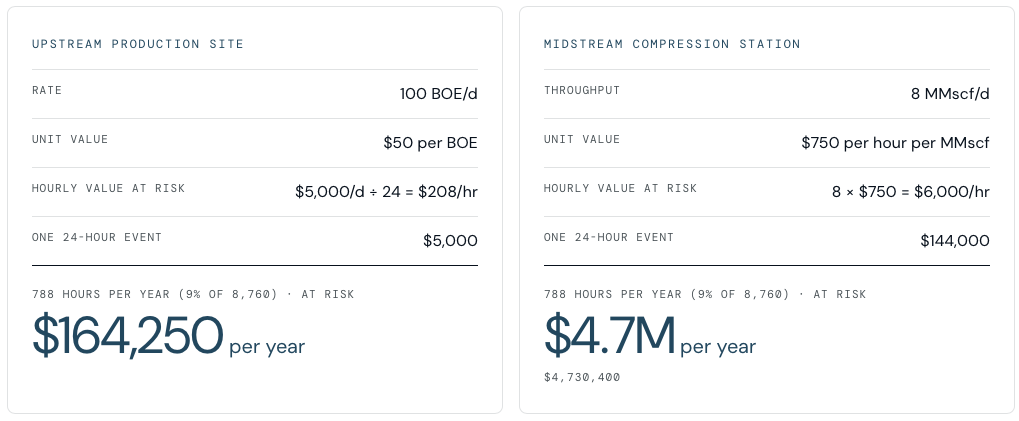
What those hours cost depends on what the site produces or moves. Upstream, a site producing 100 BOE/d at $50/BOE generates $208 per hour, so 788 hours puts $164,250 of production at risk of deferral or loss every year. Midstream, downtime is measured in throughput. In discussion with midstream reliability engineers, Kathairos was told that the working cost of downtime is $750 per hour for every MMscf of throughput. An 8 MMscf/d compression station therefore carries $6,000 per hour: $144,000 for a 24-hour event and $4.7 million across 788 hours.
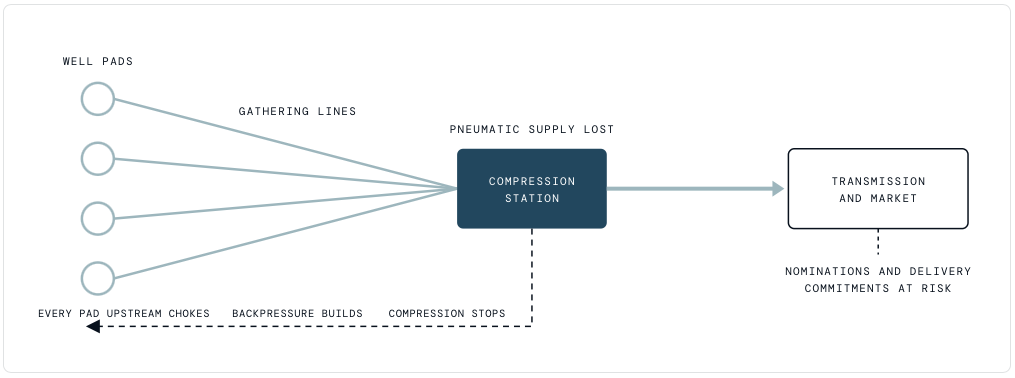
The cost does not stop at the station. A pneumatic failure stops compression, builds backpressure and chokes every pad upstream, and it puts nominations and delivery commitments at risk.
Cheap Insurance
Pneumatic reliability matters most where an hour offline costs the most: high-production greenfield sites, where early production carries the highest hourly value, and midstream gathering, boosting and transmission, where throughput is the product and criticality follows position in the delivery chain, not size. At these sites, the backup tank costs a fraction of one lost day. The operator keeps the IA investment in place and adds a second source sized to the site’s risk. The technician gets the one thing an outage never allows: time to fix the problem in daylight.