Kathairos has emerged as the leading North American solution for methane elimination from pneumatics, with more than 2,400 systems in operation across North America and over 70 major oil and gas producer partners.
In this post
Pneumatic controllers and pumps are the single largest source of routine methane venting on a producing well site. They’re also, when you understand the options, one of the most straightforward emissions problems to solve.
This guide covers what each available solution actually is, how each one performs operationally, and where each one fits — or doesn’t. No manufacturer spin. Just the information operators need to make the right call.
First, What Are We Solving?
Pneumatic controllers are automated instruments that maintain process parameters — liquid level, pressure, temperature — using pressurized gas to actuate control valves. On most well sites built before 2020, that gas is wellhead natural gas. Every actuation vents a small amount to the atmosphere, and cumulative emissions across a portfolio are significant.
Non-emitting alternatives include nitrogen gas, instrument air, or solar-powered electric actuation — anything that eliminates methane as the working fluid.
The question for operators is not whether to convert. It’s which path delivers reliable, scalable, economically defensible results across their assets.
The Available Solutions
1. Liquid Nitrogen (LN2) Substitution
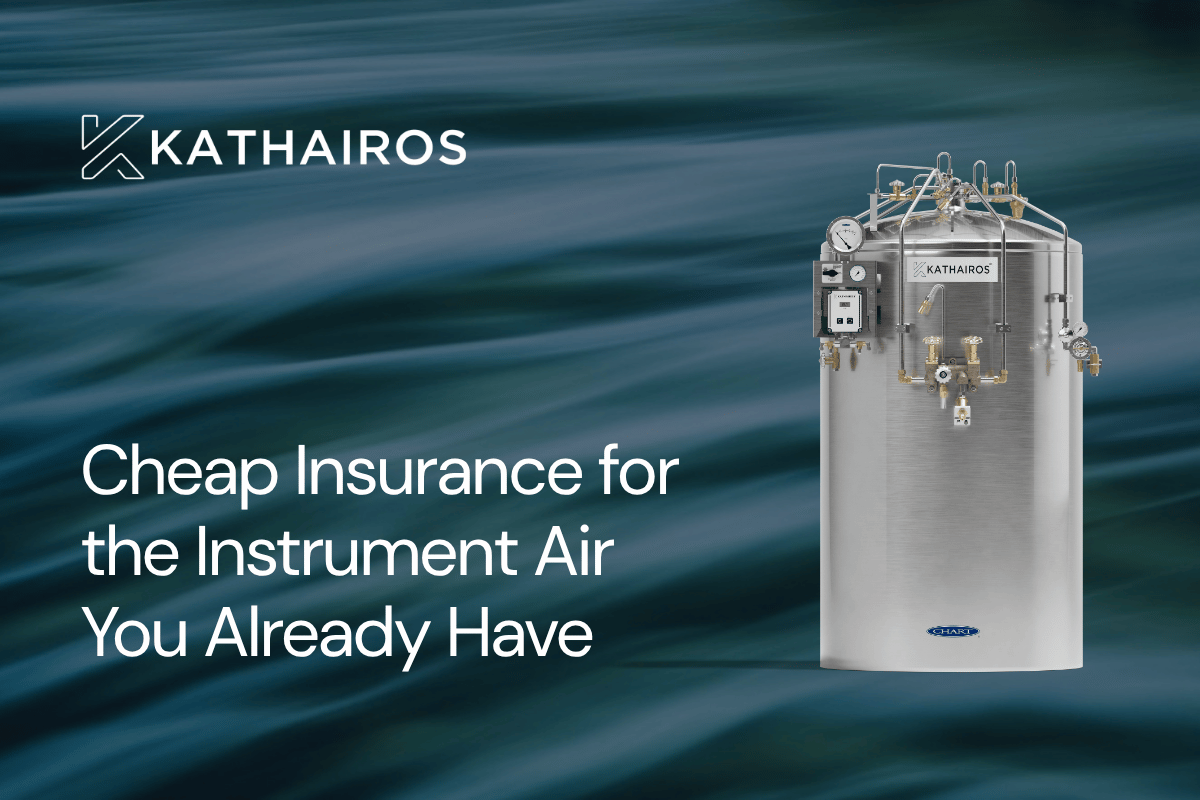
Liquid nitrogen is stored onsite in a cryogenic tank. As nitrogen transitions from liquid (-320°F) to ambient-temperature gas, the thermodynamic energy of that phase change generates all the pressure needed to operate pneumatic controllers and pumps — with no moving parts, no external power, and no modification to existing devices. After actuation, nitrogen simply vents to the atmosphere — inert and atmospherically benign.
The cryogenic tank arrives by picker truck and ties into the existing pneumatic instrument gas line in roughly two hours. Existing level controllers, pressure regulators, and pneumatic pumps all remain in service. The tank runs autonomously, monitored remotely, with refill cycles typically exceeding 30 days.
How it performs:
- No moving parts; fully off-grid, no external power.
- Kathairos reports documented uptime of 99.99% across 45 million+ operating hours.
- Operating range of −50°F to 110°F; no moisture and no freeze-off exposure.
- Ties into the existing instrument-gas line in roughly two hours; no device replacement.
- Monthly rental model with zero upfront capital; order-to-field in eight weeks or less.
- Consumption-based data is OGMP 2.0 Level 4-approved and accepted under Alberta's TIER offset protocol – audit-grade, not an add on.
Best Fit:
- Remote, off-grid sites.
- Cold-climate operations.
- Brownfield conversions where device replacement is disruptive.
- Greenfield and new-build sites in jurisdictions prohibiting fuel-gas pneumatics from day one.
- Midstream pneumatic applications — compressor stations, gas gathering systems, and processing facilities.
- Portfolio-scale programs requiring rapid, repeatable deployment across hundreds or thousands of sites.
2. Instrument Air (IA) Compressor Systems
A compressor draws ambient air, filters and dries it, and delivers compressed air to operate pneumatic devices in place of natural gas. Systems range from small solar-powered micro-skids to large, grid-connected compressor packages with air dryers, filtration systems, and buffer tanks.
Instrument air achieves zero pneumatic methane emissions, but introduces rotating equipment that requires maintenance — compressor, motor, belts, filters — along with an external power requirement (grid, solar/battery, or combustion engine). Moisture management is critical: inadequate air drying leads to freeze-ups in cold climates, a documented failure mode for solar-powered IA systems in northern operations. Each site deployment involves engineering assessment, civil preparation, equipment installation, and commissioning — a more capital-intensive process that doesn’t simplify at portfolio scale.
How it performs:
- Achieves zero pneumatic methane emissions at the device.
- Introduces rotating equipment —compressor, motor, belts, filters — that requires ongoing maintenance.
- Requires an external power source: grid, solar/battery, or combustion engine.
- Moisture management is critical; inadequate drying causes freeze-ups in cold climates, a documented failure mode for solar IA in northern operations.
- Each site involves engineering, civil prep, installation, and commissioning — complexity that does not simplify at portfolio scale.
Best Fit:
- Grid-connected facilities with high, consistent pneumatic demand that justifies the infrastructure investment.
- Midstream facilities or large processing plants where IA infrastructure already exists.
Limitations:
Not well-suited for remote, off-grid, or marginal well sites. Cold-climate reliability depends on moisture management. Capital and maintenance costs require careful total-cost-of-ownership analysis relative to site economics. Program complexity multiplies with portfolio size.
3. Electric Actuation
Electric actuation replaces the pneumatic actuator itself: an electric motor, powered by grid or by solar and battery, moves the control valve directly, so there is no gas working fluid and no supply-gas venting at all. Unlike nitrogen or instrument air — which change the supply medium and leave the existing controllers and pumps in service — electric actuation requires removing and replacing the pneumatic device at every control point.
How it performs:
- Eliminates pneumatic venting at source by removing the gas working fluid entirely.
- A recognized non-emitting compliance option; EPA and state rules list electric controllers among non-emitting devices.
- Requires continuous electric power at every actuator — grid, or solar and battery at off-grid sites.
- Introduces electric actuators, motors, and control electronics as new equipment to power and maintain.
- Retrofit means full device replacement, engineering, and wiring at each control point — cost and complexity that rise with device count.
Best fit:
- Grid-connected greenfield and new-build sites where actuation is designed electric from the start.
- Simple, low-count actuation where per-point replacement is manageable.
- Sites already undergoing electrification or automation upgrades.
Limitations:
Power-dependent; struggles at remote and off-grid sites where power must be generated and maintained at every point. Higher per-point cost and retrofit complexity across large, dispersed device populations. Converting an installed pneumatic base is a heavy capital rebuild, not a supply change.
Side-by-Side Comparison
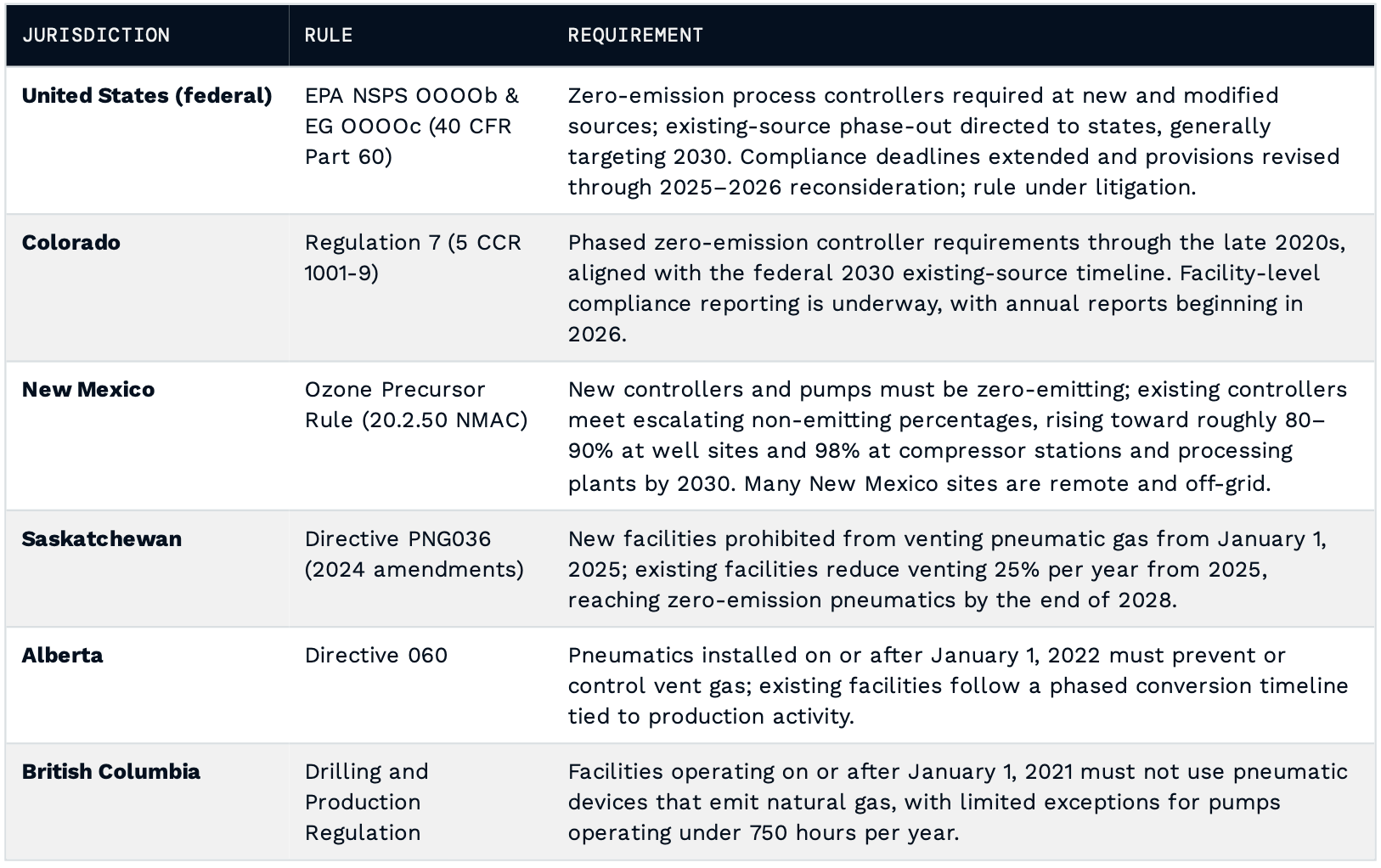
How Regulations Shape the Decision
The regulatory direction across North America is consistent: new installations must be non-emitting from day one, and existing natural-gas-driven pneumatics must convert on defined schedules.
The Bottom Line
Liquid nitrogen substitution addresses the broadest range of operational contexts — remote, off-grid, and cold-climate sites — with the fewest infrastructure prerequisites, and it keeps existing devices in service. Instrument air is viable for grid-connected, high-demand facilities where the capital is warranted. Electric actuation fits grid-connected greenfield sites built electric from the start — but retrofitting it across an installed base means replacing every pneumatic device, a power-dependent rebuild rather than a supply change.
No single technology fits every scenario. But for operators managing portfolios across diverse geographies and site types, the solution that deploys consistently, performs reliably through every season, and generates defensible data at scale delivers the most durable compliance outcomes.
KATHAIROS HAS BEEN DEPLOYED AT THOUSANDS OF SITES ACROSS 17 NORTH AMERICAN SHALE BASINS BY MORE THAN 70 UPSTREAM AND MIDSTREAM PRODUCERS. TO LEARN HOW WE CAN SUPPORT YOUR ENTERPRISE EMISSIONS PROGRAM, FILL OUT THE FORM HERE.