Kathairos has emerged as the leading North American solution for methane elimination from pneumatics, with more than 2,400 systems in operation across North America and over 70 major oil and gas producer partners.
In this post
Pneumatic controllers and pumps do not run on air. They run on pressure. That distinction is not semantic — it is the First Law of Thermodynamics, and it carries a price tag that compounds across every site, every year, and every compressor in your portfolio.
To illustrate this point, “rain is free”… but clean, pressurized, water delivered reliably to your home is not. The cost of drilling a well, the pump, the power, the treatment system, and the planned/unplanned maintenance are all on the homeowners tab. Instrument air is identical in structure. The feedstock is abundant. Everything required to make it useable is not.
Complexity is the Enemy of Reliability
System reliability is the product of all component reliabilities. A standard instrument air package — compressor, desiccant dryer, coalescing filter, pressure regulator, and power supply — with each component at a generous 99% individual reliability produces a combined system reliability of 95.1% (0.99⁵). At a continuously operating facility, that is 429 hours — roughly 18 days — of expected degraded or unavailable instrument air per year. This is not a hypothetical. It is the direct mathematical consequence of accumulating components in series.
The European Forum for Reciprocating Compressors (EFRC) 2019 Compressor Reliability Survey provides industry-validated availability bands for upstream IA service: recip simplex 90.0–97.8%, recip duplex N+1 lead-lag 94.0–99.0%, screw duplex N+1 98.5–99.7%. Even the upper bound of duplex N+1 reciprocating availability — the highest-cost, highest-redundancy configuration — leaves roughly 88 hours per year of expected unavailability per site. Compounded across a portfolio, this is an operating budget item that is rarely budgeted.

That number worsens if maintenance is not performed to schedule. Deferred service on a reciprocating compressor does not produce a static degraded system — it produces an accelerating one. Output pressure drops, duty cycle increases to compensate, and wear compounds. Critically: a system sized for a leak-free pneumatic network becomes an undersized, overworked system the moment leaks develop — and pneumatic leaks are operationally common, often invisible, and progressive. The compressor responds by running harder, shortening remaining service life, and advancing the next failure event. EFRC failure-mode data shows that 82% of reciprocating compressor failures are valve-related, precisely the wear class accelerated by sustained over-duty operation.
This is why N+1 lead-lag architecture is the engineering default — not over-engineering, but a formal acknowledgment that primary system failure is statistically certain across a long enough horizon. N+1 doubles the maintenance obligation, the spare parts inventory, and the service footprint in exchange for recovering the reliability that the system’s own complexity consumed. Where reliability is non-negotiable (ESD-critical sites, severe climates, sites with MTTR over 2 hours), even N+1 reciprocating cedes ground to rotary screw at a CAPEX premium of 30–55%.
From Site Reliability to Enterprise Risk
A single-site reliability of 95.1% sounds manageable in isolation. Extended to a 100-site operating portfolio, the math becomes an enterprise risk conversation.[4]
The probability that all 100 sites are simultaneously available on any given day: 0.951¹⁰⁰ = 0.6%. Stated the other way: there is a 99.4% probability that at least one site in a 100-site fleet is experiencing an IA availability event at any given moment. Not occasionally. Continuously.

Annualized across the fleet: 100 sites × 429 hours/site = 42,900 hours of IA unavailability per year. Equivalent to 4.9 site-years of lost instrument air annually — from a portfolio running equipment at 99% per-component reliability, an assumption already generous for remote oilfield service.
Each availability event requires a field response: diagnosis, dispatch, parts, remote site travel, repair. At 2 unscheduled events per site per year across 100 sites, that is 200 field service callouts annually. The U.S. Bureau of Labor Statistics reports a 2024 median annual wage of $63,510 for industrial machinery mechanics, machinery maintenance workers, and millwrights — the labor class servicing IA compressors. Fully-loaded field labor cost (wage + benefits + vehicle + overhead) at $85/hour with 12 hours per event yields $204,000/year in field labor alone — before parts, before lost production, before backup compressor capital.
The Kathairos managed service has one scheduled field interaction per site: LN₂ refill on a 30+ day cycle. No mechanical failure modes generate unscheduled dispatch. Across 100 Kathairos sites, expected reactive callouts approach zero — not because sites are managed more carefully, but because the failure surface has been physically removed. See Appendix C for the complete fleet reliability model.
Compressing air to 100 psig requires continuous shaft work. Power for that shaft work is a non-negotiable, recurring cost.
The engineering-correct approach for energy modeling is specific power — the kilowatts of electrical demand per SCFM of delivered air at design pressure. Per the Compressed Air & Gas Institute (CAGI) Compressed Air & Gas Handbook 7th Edition, representative specific power values at 100 psig discharge are: reciprocating two-stage 0.20–0.22 kW/SCFM, oil-injected rotary screw with variable frequency drive 0.18 kW/SCFM at average load. Reciprocating compressors carry an additional part-load penalty when average load factor drops below 0.50 — they unload inefficiently, with effective specific power rising approximately 0.30 kW/SCFM per 1.0 fractional decrease in load factor below the threshold.
The relevant power rate is not the EIA large-industrial average. Large industrial facilities sit adjacent to transmission infrastructure; remote oilfield sites do not. Upstream and midstream facilities served by rural electric cooperatives or utility distribution extensions pay basin-specific commercial tariffs that materially exceed industrial averages.
Basin-specific power and PM cost assumptions (commercial team validation, April 2026):
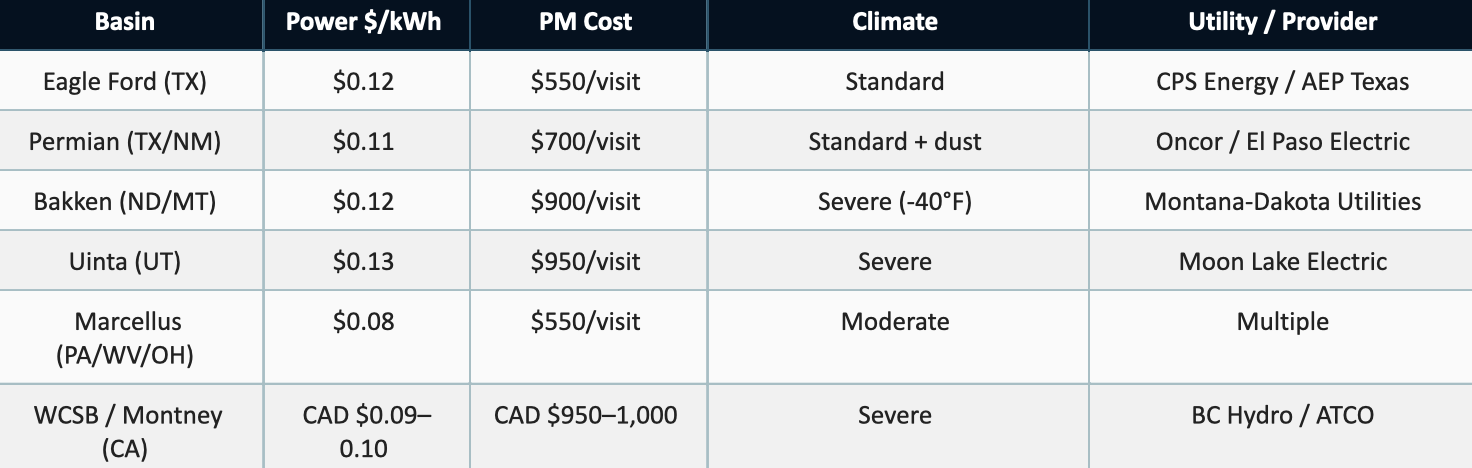
In the Permian Basin specifically, grid congestion has become acute enough that Texas regulators are now overseeing a $13 billion Permian Basin Reliability Plan — a transmission buildout still working through ERCOT and Public Utility Commission review with completion timelines extending to 2030. Operators cannot pace new development to power infrastructure buildout. Grid access in active oilfield regions is constrained, permit-dependent, and uncertain — adding months to years of lead time that production economics cannot absorb.

What Ownership Actually Costs
Atlas Copco’s compressor lifecycle guidance is direct: budget 5–10% of compressor capital annually in maintenance. Natural Resources Canada’s Compressed Air Energy Efficiency Reference Guide documents that purchased equipment represents only 12% of lifetime cost — energy (76%) and maintenance (12%) constitute the other 88%, paid by the operator, year after year, whether production is up or down.
That lifecycle profile understates the full ownership ledger. A complete IA package OPEX accounting includes ten distinct annual line items (Appendix B details the calculation chain):
- O1: Power consumption (loaded + lag parasitic draw)
- O2: Planned maintenance visits (2x/yr recip; semi-annual minimum per OEM)
- O3: Desiccant dryer media replacement (3–5 yr life; amortized)
- O4: Coalescing and after-filter element replacement (4,000–8,000 hr intervals)
- O5: Lubricating oil changes (500–2,000 hr recip intervals)
- O6: Unplanned R&M from failure events (EFRC: $1,400–$2,400/yr recip mid)
- O7: Airend rebuild amortization (screw only, 22,500 hr typical interval)
- O8: ASME vessel inspection and registration ($300–$800/yr per system)
- O9: Dew point monitoring and telemetry (if specified)
- O10: OPEX escalation at 3.0%/yr (US CPI services long-run average)
An operator with 100 IA-equipped sites is not managing 100 compressors. They are managing 100 instances of all ten OPEX lines, each on its own service cycle, each requiring technician dispatch to remote locations. That labor does not scale linearly — it scales by headcount, dispatch route density, and the geographic reality of remote sites with uncertain road and weather access.
The operator who capitalized those 100 compressors made one CAPEX decision. The OPEX that decision created runs indefinitely. See Appendix D for a worked example: a 5 HP reciprocating duplex N+1 IA package across a 100-site Eagle Ford portfolio.
Why Nitrogen Compounds in the Opposite Direction
Liquid nitrogen vaporizes by absorbing ambient heat — no motor, no shaft work, no power supply, no moving parts. The Kathairos system relies on the thermodynamic transformation of nitrogen from liquid to gas, which requires no external power source or mechanical parts. That is not a marketing claim. It is the description of a closed-system phase-change process with no mechanical wear modes.
The working gas matters as much as the delivery mechanism. Nitrogen is inherently anhydrous, hydrocarbon-free, and particulate-free — meeting ISO 8573-1:2010Class 0 purity at source, without a treatment train. Moisture-driven valve seat corrosion, elastomer seal failure from oil carryover, and orifice scoring from particulates are not mitigated — they are physically eliminated. Pneumatic device longevity improves not because the system is better managed, but because the contamination mechanisms that cause device-level failures no longer exist.[10]
Where IA system complexity multiplies failure probability with every component added, nitrogen removes those components entirely. The reliability improvement is not incremental — it is structural.

The Honest Ledger
“Air is free” is not wrong. It is incomplete. The feedstock costs nothing. Converting it into a reliable pressurized working gas — and sustaining that reliability at scale, across a remote portfolio, over years — costs a great deal, and compounds with every site added and every year deferred.
Nitrogen supply costs money. The difference is that it is the only cost. Transparent, predictable, and managed. There is no hidden bill compounding quietly behind the CAPEX decision.
.png)