Kathairos has emerged as the leading North American solution for methane elimination from pneumatics, with more than 2,400 systems in operation across North America and over 70 major oil and gas producer partners.
In this post
A compressor station in the Anadarko goes down at 2 a.m. in January. The culprit isn't the compressor. It isn't the gas. It's the instrument air package — frozen up, again — and now you have a facility trip, a production interruption, downstream nomination failures, and a field tech driving four hours in the dark to fix a problem that was entirely predictable.
Most midstream operations managers have this story memorized. Many have lived it more than once this winter alone. The real cost isn't the service call — it's the throughput loss, the line pack imbalance, the royalty obligations on gas you couldn't move, and the conversation with your VP the next morning. The industry has managed around this failure mode for decades by treating it as a cost of doing business.
It isn't. It's a choice. And a growing number of North American midstream operators — including some of the largest gathering and compression companies on the continent — have stopped making it.
The Physics Are Not on Instrument Air's Side
Compressor stations are demanding environments for pneumatic control. Process controllers managing pressure, level, and flow run continuously, at variable throughput, through temperature swings that can exceed 100°F between seasons. The pneumatic supply to those controllers needs to be dry, clean, inert, and uninterrupted.
Instrument air introduces three failure modes that nitrogen eliminates entirely.
Moisture. Compressed air carries water vapor. Even with drying systems, moisture ingress into pneumatic supply lines is persistent — and in northern climates, it is the primary driver of the freeze-up events that trip facilities. Nitrogen is inherently dry. There is no moisture to freeze, no redundant dryer to maintain, and no freeze-up to manage.
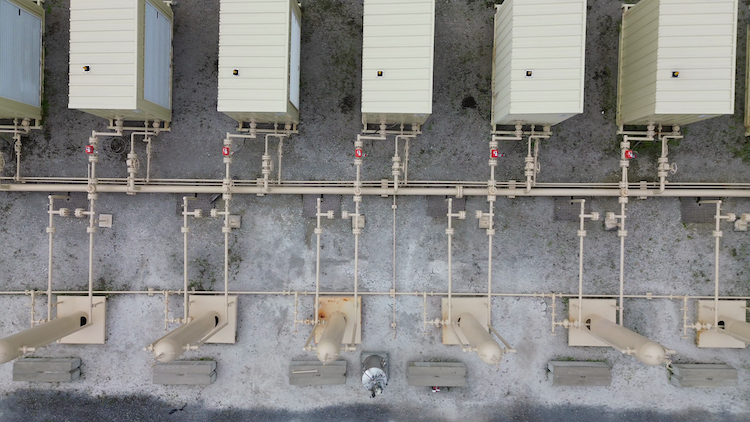
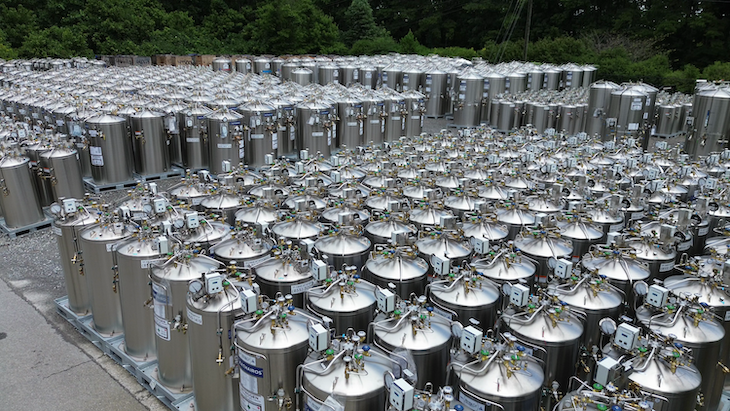
Moving parts. An instrument air package is a compressor, a dryer, an aftercooler, filters, and associated electrical systems — each a potential failure vector. When any part fails at a remote gathering station, pneumatic supply to the entire facility is compromised. The Kathairos system has no moving parts. Liquid nitrogen stores in a cryogenic vessel onsite, vaporizes through a controlled regulator, and delivers clean supply gas to every controller on the station. There is nothing to break down.
Power dependency. Many gathering stations operate without reliable grid access — or with power planned for later phases of development. Instrument air requires power. Nitrogen does not.
Eliminating those three failure modes produces a measured uptime record of 99.99% across 36 million operating hours at 2,400+ deployed systems from the Montney to the Permian. That is the documented operating history of this solution in the harshest field environments in North America — not a spec sheet projection.
What This Means at Your Station
Operators who have made the switch describe the impact in consistent terms: freeze-up events stop entirely, maintenance burden drops to near zero, and the field tech time that was going to instrument air upkeep goes back to the operation. Controllers that were producing erratic actuation behavior due to moisture-contaminated air supply operate cleanly on dry, inert nitrogen. Pneumatic device longevity increases. Elastomers, valve seats, and orifice components that were degrading from moisture and VOC exposure run in a clean medium.
Integrated telemetry provides near real-time venting and consumption data at every Kathairos installation — turning a previously opaque emissions source into a defensible, data-backed asset for Scope 1 reporting, OGMP 2.0 Level 4 compliance, and internal emissions dashboards.
For stations that already have instrument air installed, the most common starting point isn't replacement — it's backup. A Kathairos tank in parallel with an existing IA package is the lowest-cost, lowest-footprint reliability upgrade available to a compression station. When the air compressor fails, the dryer freezes, or grid power drops, nitrogen holds pneumatic supply without interruption. No facility trip. No nomination failure. No after-hours call.
The economics are straightforward: a single unplanned facility trip at a mid-scale gathering station typically costs more in lost throughput and downstream disruption than the full annual rental cost of a backup nitrogen system. This is where most midstream operators start — one station, one winter, and the question of full conversion tends to answer itself.
The Regulatory Window Is Already Narrowing
The operational case for nitrogen at compression stands independent of regulation. The current regulatory environment compresses the timeline.
In the U.S., EPA's NSPS OOOOb requires zero-emission process controllers at compressor stations constructed, modified, or reconstructed after December 6, 2022. EPA's November 2025 final rule extended that compliance deadline to January 22, 2027. The underlying zero-emission standard has not changed — only the window. Colorado operators face a stricter state-level obligation: Regulation 7, amended February 2025, requires zero-emission pneumatics in the Front Range nonattainment area by May 2027 and statewide by March 2029.
In Canada, enhanced federal methane amendments published December 31, 2025, in the Canada Gazette, Part II now explicitly cover midstream gathering stations, boosting stations, and transmission compressor stations for the first time. New sources must comply as of January 1, 2028. EPA itself acknowledged in its rulemaking that supply chains for large natural gas-driven controller conversions require 12 to 18 months. Operators planning for a 2027 compliance date are, effectively, already in the procurement window.
Kathairos deploys in eight weeks or less from order to field. That lead time advantage is only available if the decision precedes the pressure.
The Commercial Structure Removes the Barrier
Kathairos operates on a monthly rental model — no upfront capital, no CAPEX commitment, eligible for IFRS 16 lease treatment where operators choose to capitalize. Whether deployed as a full replacement for gas-driven controllers, a direct substitute for instrument air, or a backup system running parallel to an existing IA package, the commercial structure is identical: a managed monthly service that scales across a portfolio without an AFE battle.
Seven tank sizes allow right-sizing to actual pneumatic consumption — not worst-case design loads. Tank sizes adjust as throughput changes over the station's life.
The companies that have already made this decision include some of the most operationally rigorous midstream and upstream operators in North America — Kinder Morgan, ExxonMobil, Chevron, ConocoPhillips, and 65+ others. They didn't act because a regulation forced them to. They acted because reliable operations and unnecessary failure modes are incompatible — and once you understand the alternative, continuing to manage around instrument air failures stops being pragmatic and starts being optional.
Start with your most failure-prone station. A site assessment takes less than a week. Deployment follows in eight weeks. The conversation that proves the case tends to be the first winter you don't take that 2 a.m. call.
Reach out directly to schedule your site assessment: hello@kathairos.com
Explore more posts from Kathairos
Electrification? I Barely Knew Her: Why power access isn’t needed to eliminate methane emissions at remote well sites